
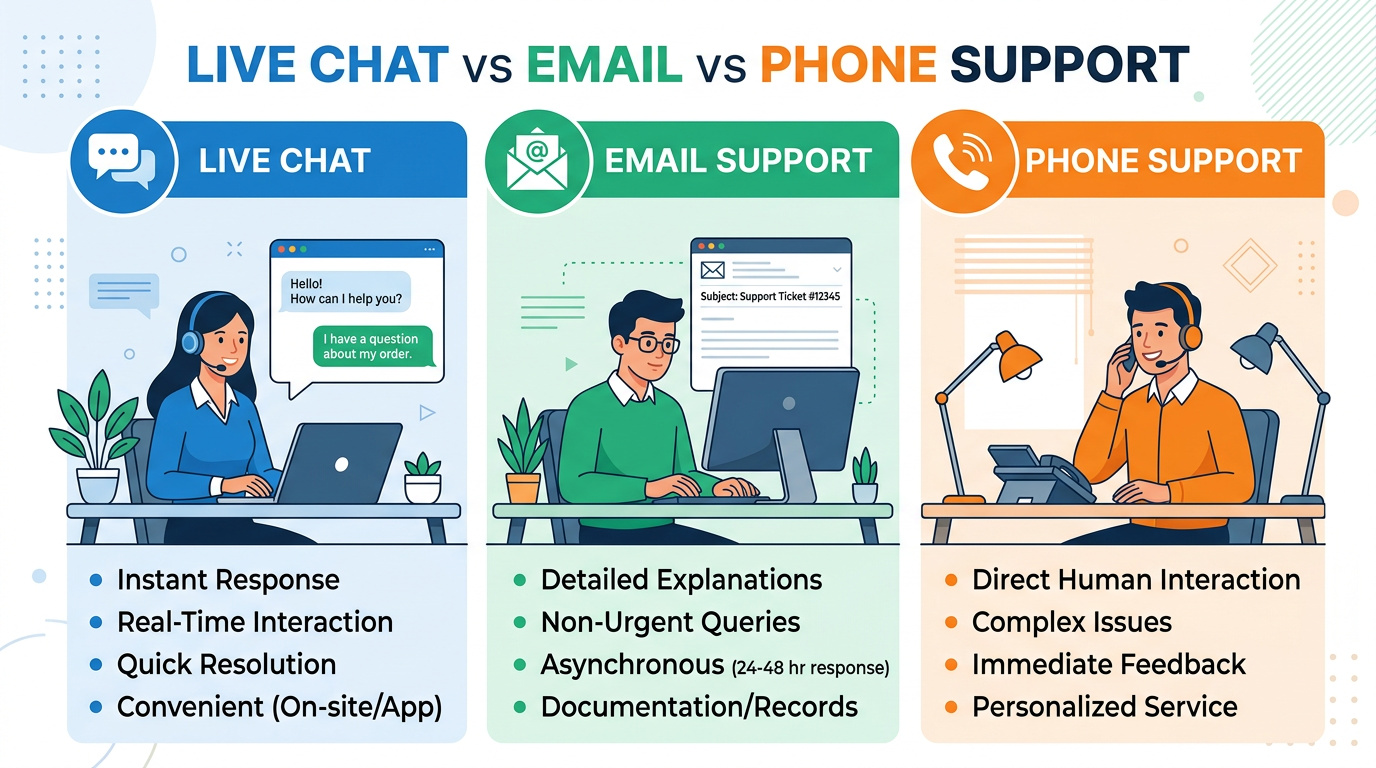
Live Chat vs Email vs Phone Support Offshore
Customer support is one of the most visible parts of any business. It directly shapes customer experience, retention, and brand perception. As businesses scale, managing support internally becomes more complex and costly, which is why many turn to offshore solutions.
However, choosing the right communication channel is just as important as choosing where your team is based. Live chat, email, and phone support each serve different purposes, and understanding how they function in an offshore setup is key to building an effective support strategy.
How Customer Expectations Have Changed
Customers today expect fast, accurate, and convenient support. Response times are shorter, and tolerance for delays is lower.
This shift has changed how businesses approach customer service. Instead of relying on a single channel, companies now need a mix of support options that match different customer needs and situations.
Some customers prefer quick answers through chat, while others want detailed responses via email or direct interaction through phone calls.
Understanding the Three Core Support Channels
Each support channel plays a unique role in customer service operations. Choosing the right mix depends on your business model, customer base, and service expectations.
Live Chat Support
Live chat is designed for speed and convenience. It allows customers to get immediate answers while browsing a website or using a product.
It is best suited for:
- Quick questions and issue resolution
- Sales inquiries and pre-purchase support
- Real-time troubleshooting
Live chat also enables agents to handle multiple conversations at once, improving efficiency.
Email Support
Email remains a critical support channel, especially for more detailed or non-urgent inquiries.
It is ideal for:
- Complex issues that require documentation
- Follow-ups and case tracking
- Customer complaints or escalations
Email allows for more thoughtful and structured responses, making it suitable for situations where accuracy matters more than speed.
Phone Support
Phone support provides direct, real-time communication and is often preferred for urgent or sensitive issues.
It works best for:
- High-priority concerns
- Technical troubleshooting requiring step-by-step guidance
- Situations where empathy and human interaction are critical
While effective, phone support typically requires more resources and higher operational costs.
Comparing Live Chat, Email, and Phone Support
| Factor | Live Chat | Phone Support | |
|---|---|---|---|
| Response Time | Immediate | Slower | Immediate |
| Cost Efficiency | High | High | Lower |
| Complexity Handling | Low to moderate | Moderate to high | High |
| Scalability | Very high | High | Moderate |
| Customer Preference | Growing rapidly | Stable | Still important |
| Agent Efficiency | Can handle multiple chats | One case at a time | One call at a time |
Where Offshore Support Changes the Equation

Offshore support does not just reduce costs. It allows businesses to build dedicated teams that can handle multiple channels efficiently.
With the right structure in place, offshore teams can:
- Provide 24/7 coverage
- Maintain consistent response times
- Handle high volumes of inquiries
- Scale quickly as demand increases
This is especially valuable for businesses that experience fluctuating support needs.
Choosing the Right Channel Mix for Your Business
There is no single best channel. The right approach is often a combination of all three.
When to Prioritize Live Chat
- E-commerce businesses
- SaaS platforms
- High website traffic environments
When to Prioritize Email
- B2B services
- Detailed support requirements
- Documentation-heavy workflows
When to Prioritize Phone Support
- High-value customers
- Technical services
- Urgent or sensitive issues
Most successful businesses use a blended approach, where each channel supports a specific function. To make this work effectively, it is important to hire the right team with the right capabilities. Refer to this guide for hiring offshore customer support agents when building support operations.
Balancing Cost and Customer Experience
Cost is a major factor when building a support team, but it should not come at the expense of customer experience.
Live chat and email are generally more cost-efficient because agents can manage multiple tasks simultaneously. Phone support, while more expensive, delivers higher engagement and problem resolution for complex issues.
By leveraging customer service offshore in the Philippines, businesses can maintain high-quality support across all channels while keeping operational costs under control.
How Process and Training Impact Support Quality
Regardless of the channel, the success of offshore support depends on structure and training.
Key elements include:
- Clear workflows for each support channel
- Defined response time targets
- Knowledge base and documentation
- Ongoing training and quality monitoring
Without these, even the best support channels can become inconsistent.
Integrating Offshore Teams Into Your Operations
One of the most common concerns about offshore support is integration. Businesses often worry about alignment, communication, and performance.
These challenges are addressed through:
- Structured onboarding processes
- Regular communication and reporting
- Use of shared tools and systems
- Defined performance metrics
When integrated properly, offshore teams operate as a natural extension of the business.
How EVES Supports Offshore Customer Service Teams
Building an effective offshore support team requires more than just hiring agents.
EVES helps businesses create structured offshore customer service teams in the Philippines by managing recruitment, onboarding, payroll, and HR processes. This allows companies to focus on customer experience while ensuring that their support teams are consistent, reliable, and aligned with business goals.
What This Means for Your Customer Support Strategy
Choosing between live chat, email, and phone support is not about picking one over the others. It is about designing a system that meets customer expectations while remaining efficient and scalable.
Offshore support enables businesses to:
- Expand coverage without increasing overhead
- Improve response times across all channels
- Deliver consistent customer experiences
- Scale support operations as the business grows
With the right mix of channels and a structured offshore approach, customer support becomes a competitive advantage rather than a cost center.
Ready to Build a Scalable Customer Support Team?
If you are looking to improve your customer support while reducing costs, EVES can help you build a high-performing offshore team tailored to your needs.
Contact us today to learn how to scale your customer service operations with confidence.