
Comprehensive Guide to Outsourcing Web Development
Web development is one of those functions that businesses almost never get exactly right on the first try. In-house teams are expensive to build and maintain, and the skill range required (frontend, backend, CMS configuration, performance optimization, security patching, API integrations) rarely maps neatly onto a single hire. Freelancers offer flexibility but inconsistency. Agencies deliver polished proposals and then hand the project to a junior developer three weeks in.
Outsourcing web development offshore is increasingly the option businesses land on, not as a last resort but as a deliberate structural choice. Done well, it solves for cost, capacity, and continuity at the same time. Done poorly, it creates the same problems as every other approach, just with the added friction of time zone coordination.
This guide is about doing it well.
Start with the Work, Not the Hire
The most common mistake in web development outsourcing is beginning the process by looking for a developer before understanding precisely what the developer needs to do. “We need someone who can handle our website” is not a brief. It is the beginning of a mismatch.
Before any recruitment conversation, map out the actual work the role involves. That means identifying whether you need new build capability, ongoing maintenance, feature development on an existing platform, performance and speed work, CMS management, e-commerce development, or some combination of these. Each of those has a distinct skill profile, and a candidate who excels at custom React builds may not be the right fit for a business that runs on WordPress and needs reliable plugin management and content updates.
The clearer the brief, the shorter the hiring process and the more accurate the candidate matching. Ambiguous briefs attract candidates who oversell their breadth and underdeliver on depth.
The Web Development Skill Landscape: What You Are Actually Hiring For
Web development is not a single skill. It is a family of disciplines, and understanding the distinctions helps enormously when evaluating candidates or deciding whether one hire is enough.
| Role | Primary Skills | Typical Use Cases |
|---|---|---|
| Frontend Developer | HTML, CSS, JavaScript, React, Vue, or Angular | User interfaces, responsive design, web app UX |
| Backend Developer | Node.js, PHP, Python, Ruby, databases, APIs | Server logic, data handling, integrations |
| Full-Stack Developer | Combined frontend and backend capability | Projects needing end-to-end ownership |
| CMS Developer | WordPress, Webflow, Shopify, Squarespace | Content-managed sites, e-commerce builds |
| Web Application Developer | Framework-heavy development (Next.js, Laravel, Django) | Custom web apps, SaaS platforms |
| Web Maintenance Specialist | Updates, security patches, performance monitoring | Ongoing site health for established platforms |
| UI/UX-Focused Developer | Design systems, Figma implementation, accessibility | Businesses where design-to-code quality is critical |
Most businesses at the SMB level need a full-stack or CMS developer, not a specialist at either extreme. Most enterprises find they need to separate those disciplines across multiple hires as scope grows. Knowing which profile fits your situation prevents hiring someone technically impressive but wrong for the actual job.
Project-Based vs. Dedicated Offshore Developer: Choosing the Right Model

This is a decision point that shapes everything downstream, and most businesses do not think carefully enough about it before committing.
Project-based outsourcing means engaging an offshore team or individual for a defined scope of work with a start and end point. A new website build, a platform migration, a specific feature set. This model works when the scope is genuinely bounded and unlikely to evolve significantly during execution. It tends to underperform when the business is still clarifying what it wants, because the offshore party has an incentive to deliver against the spec as written rather than raising concerns about whether the spec reflects the actual need.
Dedicated offshore developer means hiring a full-time or near-full-time remote professional who works exclusively within your business, across your projects, using your tools and your processes. This model produces stronger results over time because the developer builds genuine familiarity with your codebase, your preferences, and your technical context. The relationship is direct. The accountability is clear.
For most businesses that see web development as an ongoing operational need (which is most businesses in 2026), the dedicated model delivers better ROI than stringing together a series of project engagements.
Evaluating Offshore Web Developers: What to Actually Look For
A portfolio is a starting point, not a conclusion. Many candidates have polished portfolios built in agency environments where they contributed to one component of a larger project. What matters for an ongoing dedicated hire is something different.
Code quality and documentation habits. Ask to review code from a project they managed independently. Look at whether the code is readable, whether variable names make sense, whether there are comments where logic is non-obvious, and whether the project structure is organized in a way another developer could pick up. Good code habits are a proxy for good working habits in general.
Problem-solving under uncertainty. Give the candidate a brief, deliberately incomplete specification and ask how they would approach clarifying it before starting. How they handle ambiguity tells you more about long-term fit than what they can do when the instructions are clear.
Communication patterns. In a remote development relationship, the ability to communicate progress, blockers, and trade-offs in clear written English is not a soft skill. It is a functional requirement. Test it explicitly during the evaluation process by asking the candidate to walk you through a technical decision they made in a past project.
Familiarity with your stack. This is specific and non-negotiable. A developer who has never worked with your platform (WordPress, Shopify, Next.js, whatever your environment uses) will cost you ramp-up time that you would not pay with a well-matched candidate.
How the Philippines Became the Benchmark for Offshore Web Development
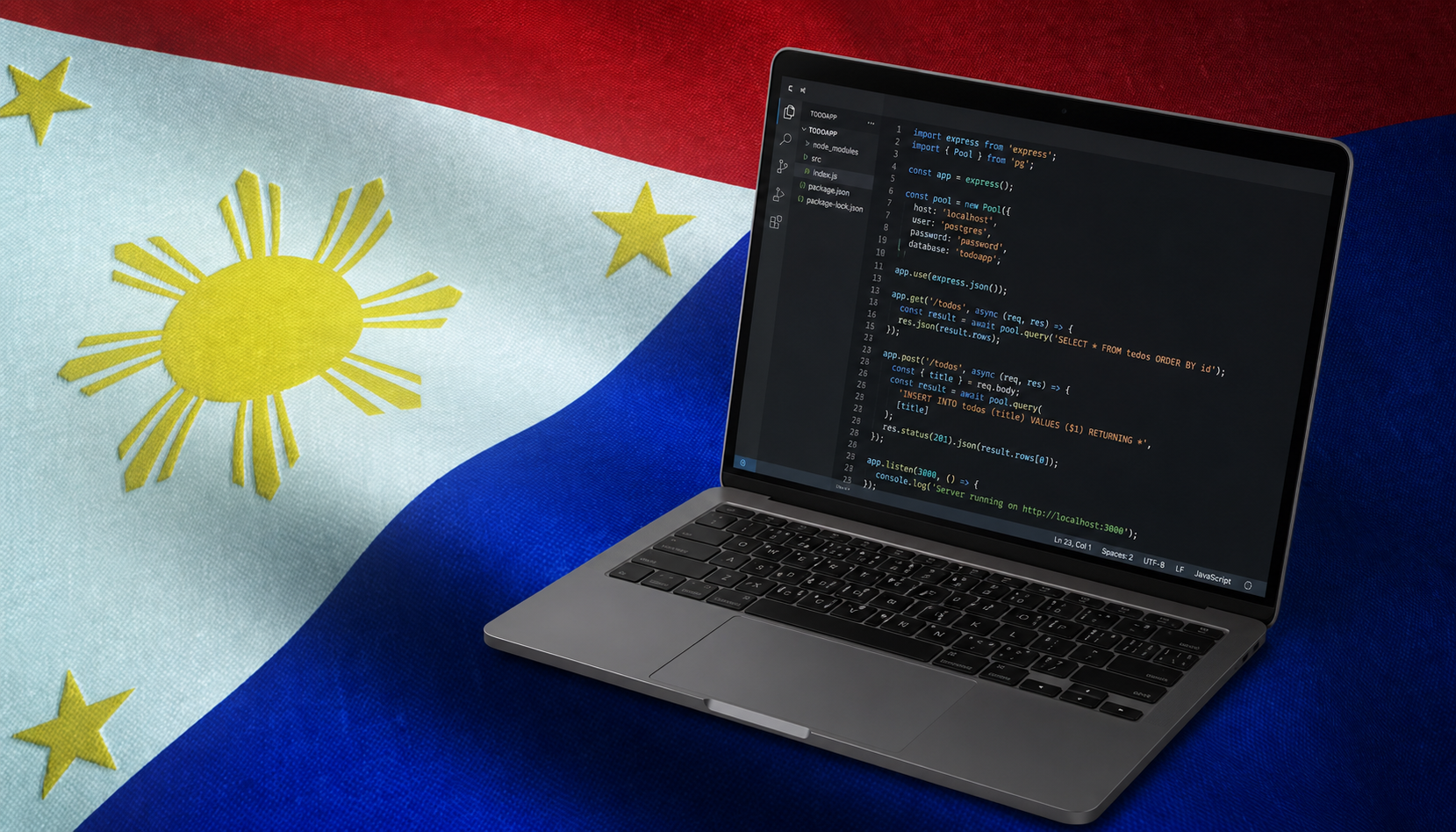
The concentration of strong web development talent in the Philippines reflects two things: a university system that has been producing IT and computer science graduates in large numbers for decades, and a working culture that has been shaped by consistent engagement with international clients across the US, Australia, and Europe.
Filipino developers working with US clients understand things that are not written in any technical specification: deployment timing considerations around US business hours, the expectation that significant changes get flagged before implementation rather than after, the value placed on documentation, and the communication frequency US clients expect. Those are cultural skills built through years of exposure to international working norms, and they matter as much as technical capability in a remote working relationship.
When businesses working with an offshore web developer in the philippines for the first time compare the experience to freelancer marketplaces or agency outsourcing arrangements, the consistent point of difference is the relationship quality. A dedicated offshore developer who has been working inside your business for six months knows your codebase, anticipates your preferences, and functions as a genuine team member rather than an external contractor executing a task.
Setting Up the Working Relationship for Consistent Output
Technical skill gets the developer through the door. Working structure determines what they produce once they are inside.
Version control is non-negotiable. All development work should happen through a version control system (Git is the industry standard) with clear branching conventions and pull request review processes. If this discipline is not in place before an offshore developer starts, establish it as part of onboarding. It protects the codebase and creates an auditable record of what changed and why.
Define the communication rhythm before day one. Daily async updates via Slack or a project management tool (what was done, what is next, any blockers) with weekly video calls for alignment and review works well for most dedicated offshore arrangements. The async layer keeps things moving without creating dependency on synchronous availability. The weekly call maintains the relationship and catches anything that is easier to resolve in conversation than in text.
Establish a staging environment. Any changes to a production website should pass through a staging or development environment first. This is standard practice that offshore developers expect and can implement, but it needs to be confirmed as part of the setup rather than assumed.
Set code review expectations from the start. Whether your internal team reviews pull requests or you rely on the offshore developer to manage the process independently, make this explicit. Unexplained expectations in code review become sources of frustration on both sides.
Why Proven Infrastructure Matters More Than You Think
Recognition that the Philippines is a Global Hub for Offshore Staffing is backed by more than reputation. The country has a mature offshore employment infrastructure: labor law frameworks that protect both employers and workers, established payroll processing systems, professional certification programs across technology disciplines, and a workforce pipeline that has been supplying international clients for 30 years.
For businesses building their first offshore web development relationship, that infrastructure matters because it reduces risk. A staffing provider operating within that ecosystem handles the compliance layer, the employment administration, and the replacement guarantee if something does not work out. The business gets to focus on managing the work rather than managing the logistics of the employment relationship.
The Decision Comes Down to One Question
Outsourcing web development offshore will not fix a development strategy that is unclear. It will not compensate for a codebase that has no documentation and no version control. And it will not produce great results when the brief is “we’ll figure it out as we go.”
What it will do, when the groundwork is in place, is give your business access to a skilled, dedicated developer who works within your systems, communicates in clear English, and treats your project with the same ownership a good in-house hire would, at a cost structure that makes it financially sustainable to invest in development properly rather than rationing it.
If that sounds like the outcome your business needs, EVES is the place to start.
EVES places experienced offshore web developers across a range of platforms and stacks, matching each client to candidates based on the specific technical requirements and working context of their business. The process moves quickly, the placement is backed by a 100% satisfaction guarantee, and the support continues after the hire starts.
Get in touch with EVES here and let us match you with the right developer for what your business actually needs to build.